Greenfield: Building New Applications
Build production-ready applications from a product specification, deployed to Azure. Two phases: Discovery (understand what to build) and Delivery (build and ship it).
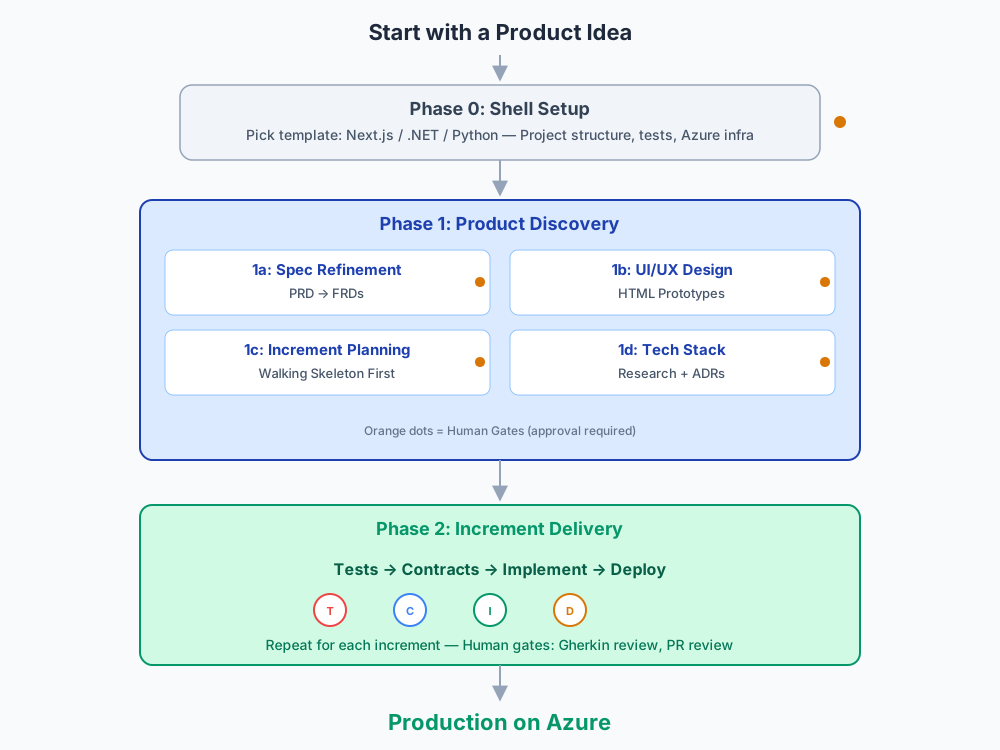
Phase 0: Shell Setup
Pick a shell template that matches your tech stack. The shell provides project structure, test frameworks, Azure infrastructure templates, and CI/CD workflows.
Before Phase 0 exits, all scaffolding must be verified: specs/ directory, .spec2cloud/state.json, .spec2cloud/audit.log, AGENTS.md, shell template files, Playwright wiring, and Azure CLI (azd) installed.
| Template | Language | Stack |
|---|---|---|
| Next.js | TypeScript | React + Express + PostgreSQL |
| .NET | C# | ASP.NET Core + Entity Framework |
| Agentic .NET | C# | ASP.NET Core + Claude AI Agent SDK |
| Agentic Python | Python | FastAPI + Claude AI Agent SDK |
Phase 1: Product Discovery
1a — Spec Refinement
Your PRD is reviewed through product and technical lenses. Up to 5 refinement passes ensure completeness: edge cases, feasibility, clarity. The PRD is then broken into individual FRDs (Feature Requirement Documents).
If the product has a meaningful workflow or lifecycle, the approved PRD should start with a Mermaid product/process diagram before the prose sections.
Human Gate: Review and approve refined PRD and FRDs before proceeding.
1b — UI/UX Design
Interactive HTML prototypes are generated from the approved specs and served via HTTP for review.
Human Gate: Review prototypes, provide feedback, approve designs.
Optional — DDD Modeling
For domain-heavy systems, run ddd-modeling after FRDs are approved. The skill
produces specs/domain/proposals.md, specs/domain/domain-model.md, and
specs/domain/database-model.md so bounded contexts, aggregates, and
persistence ownership are explicit before planning and implementation.
Human Gate: Review and approve the proposed boundaries and terminology.
1c — Increment Planning
FRDs are organized into ordered delivery increments. The first increment is always a "walking skeleton"—the minimal end-to-end path that proves the architecture works.
1d — Tech Stack Resolution
Every technology choice is researched, evaluated, and documented as an Architecture Decision Record (ADR).
Human Gate: Review tech stack choices and ADRs.
Before moving to Phase 2, the orchestrator verifies all Phase 1 artifacts exist: PRD/FRDs, all 6 UI/UX artifacts, optional domain artifacts if DDD modeling was used, increment plan, tech stack, and infrastructure contract.
Phase 2: Increment Delivery
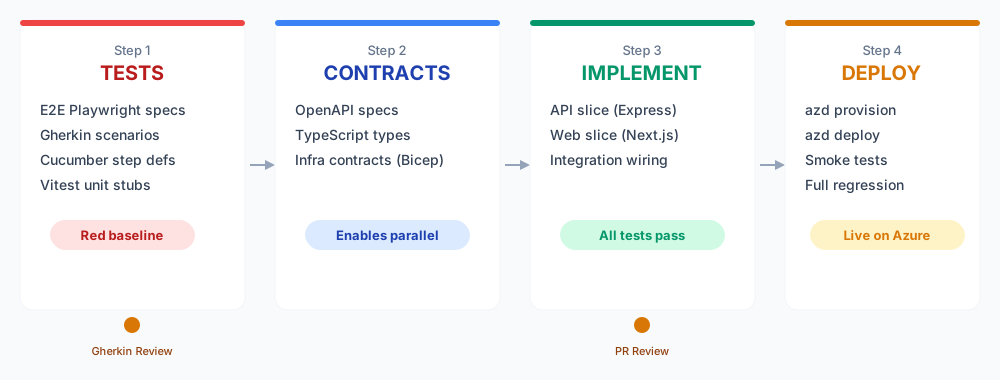
Each step transition has a prerequisite gate:
| Transition | Prerequisite |
|---|---|
| Step 1 → 2 | Tests exist, compile, and FAIL (red baseline). No test.skip(). Human approved Gherkin + tests. |
| Step 2 → 3 | Contracts exist. Shared types compile. Infra contract updated. |
| Step 3 → 4 | ALL tests pass. PR review approved. |
| Step 4 → Next | Deploy succeeded. Smoke tests pass. Human verified. |
Step 1: Tests First
- E2E specs (Playwright) from UI flows
- Gherkin scenarios from FRDs
- Unit tests (Vitest) scaffolded
- All tests run and establish a "red baseline" (they fail, as expected)
Human Gate: Review and approve Gherkin scenarios.
Step 2: Contracts
- OpenAPI specs define API boundaries
- Shared TypeScript types for request/response DTOs
- Infrastructure contracts (Azure resources via Bicep)
- Contracts enable parallel implementation of API and Web slices
Step 3: Implementation
Three parallel slices:
- API Slice: Express routes, services, models (tested with Vitest + Supertest)
- Web Slice: Next.js pages, components (tested with builds + component tests)
- Integration Slice: Wire API + Web together (tested with Cucumber + Playwright e2e)
API and Web run in parallel. Integration is sequential after both complete. Red baseline tests turn green.
If the implemented runtime flow is non-trivial, update specs/prd.md with an
as-built Mermaid implementation diagram (often a sequence diagram) before the
PR review gate.
Human Gate: PR review before deployment.
Step 4: Deploy & Verify
- Azure deployment via azd + Bicep
- Smoke tests: health checks, API health, frontend load, critical user paths
- Full e2e regression against deployed URL
- Rollback + GitHub issue if smoke tests fail
After Step 4 completes, loop back to Step 1 for the next increment.
Quality Guarantees
Every increment ships with: - ✓ 100% test coverage (unit, integration, e2e) - ✓ All tests passing on main - ✓ Live deployment to Azure - ✓ Rollback capability on failure - ✓ Zero manual deployment steps