Brownfield: Modernizing Existing Code
Transform existing codebases into spec-driven projects, then modernize, extend, or rewrite — with testability-aware testing that adapts to your app's constraints.
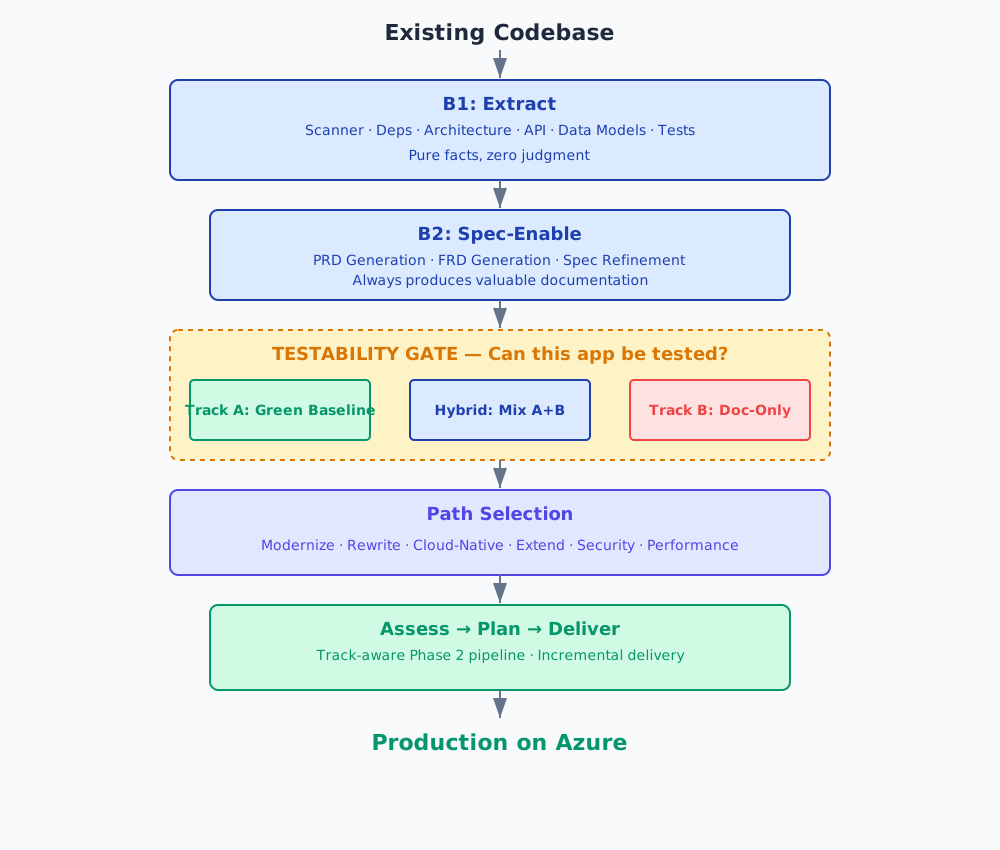
The Approach
Brownfield is harder than greenfield because you're not starting from a blank slate. spec2cloud handles this with a common trunk + branching track design:
- Extract what exists (always valuable documentation)
- Generate specs from the extraction (PRD + FRDs)
- Assess testability (can we actually test this app?)
- Capture behavior as tests or documentation (depending on testability)
- Choose a path and deliver increments
The first three steps always run and always produce valuable artifacts — even if the app can't be tested.
Phase B1: Extract
Six extraction skills scan the codebase without making any judgments:
| Skill | Output |
|---|---|
| Codebase Scanner | Technology inventory: languages, frameworks, entry points |
| Dependency Inventory | Complete catalog of all dependencies with versions |
| Architecture Mapper | Components, layers, data flow, Mermaid diagrams |
| API Extractor | Existing API contracts in OpenAPI format |
| Data Model Extractor | Database schemas, ERDs, relationships |
| Test Discovery | Existing test inventory, coverage, frameworks |
The rule: Document what IS, not what SHOULD BE. Zero judgment, zero recommendations.
Human Gate: Review extraction outputs for accuracy.
Phase B2: Spec-Enable
Two generators create formal specifications from the extraction output:
- PRD Generator — Product Requirements Document reverse-engineered from the codebase, including a top Mermaid product/process diagram when relevant and an as-built implementation diagram when useful (Human Gate)
- FRD Generator — Feature Requirement Documents with "Current Implementation" sections (Human Gate)
- Spec Refinement — Review through product + technical lenses (Human Gate)
Optional — DDD Modeling
For modular monoliths, service decomposition, or business-heavy domains, run
ddd-modeling after FRDs are approved. It combines the extracted architecture
and ERD outputs with the refined specs to produce:
specs/domain/proposals.mdspecs/domain/domain-model.mdspecs/domain/database-model.md
Brownfield DDD outputs should distinguish observed current constraints from the proposed target model.
Result: Your existing codebase now has the same specification foundation as a greenfield project — PRD, FRDs, tech stack, architecture docs, API contracts, dependency inventory, and optionally target domain boundaries.
The Testability Gate
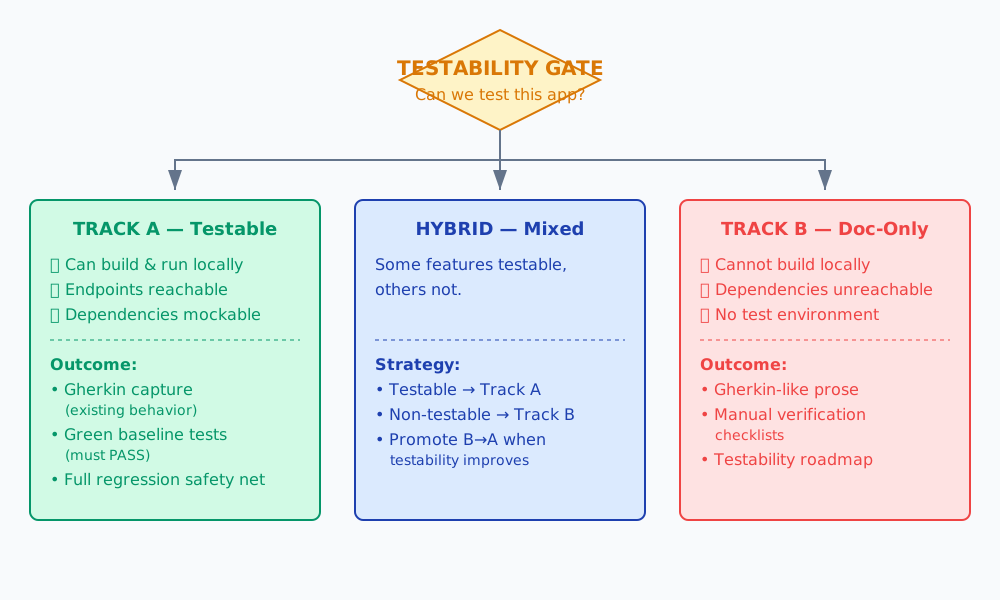
This is the most important brownfield decision. After specs are generated, you assess whether the app can be tested:
Checklist: - ☐ Can the application be built and started locally? - ☐ Are external dependencies reachable, mockable, or fakeable? - ☐ Can API endpoints be exercised? - ☐ Can the UI be rendered and interacted with? - ☐ Is there a working dev/test environment? - ☐ Can the existing test suite be executed?
Your decision determines the track:
| Outcome | Track | What happens next |
|---|---|---|
| 5-6 checked | Track A (Testable) | Green baseline — Gherkin + tests that pass on current app |
| 0-2 checked | Track B (Doc-Only) | Behavioral documentation + manual verification checklists |
| 3-4 checked | Hybrid | Track A for testable features, Track B for the rest |
Human Gate: This is a critical decision point — it shapes the entire rest of the workflow. The decision must be documented in an ADR (specs/adrs/) with rationale.
Track A: Green Baseline
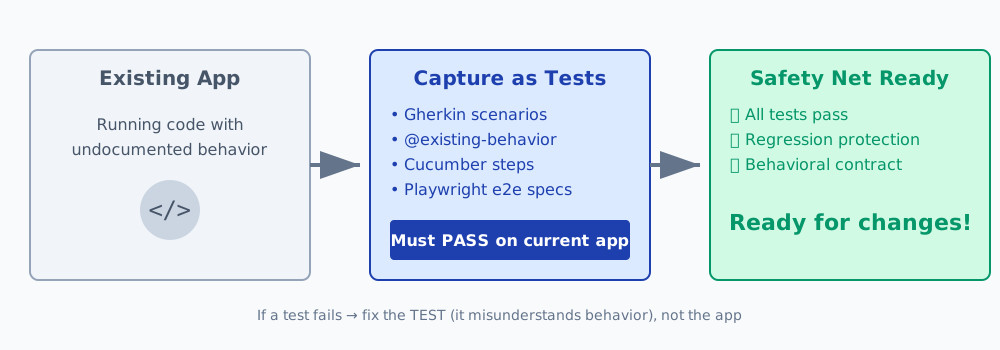
For testable apps. Capture existing behavior as executable tests that PASS against the current codebase. This creates a regression safety net before any changes.
For each feature area (iterative, one at a time):
Step 1: Gherkin Capture
Generate Gherkin scenarios describing what the app does today — not what it should do.
- Input: FRD with "Current Implementation" section + running app
- Output: .feature files tagged @existing-behavior
- Covers: happy paths, known edge cases, error handling
Step 2: Test Scaffolding
Generate tests that PASS against current code (the opposite of greenfield's red baseline). - Cucumber step definitions from Gherkin scenarios - Playwright e2e specs from user flows - Unit tests for critical business logic
Step 3: Green Verification
Run all generated tests. They must all pass. - If a test fails → fix the TEST (it misunderstands current behavior), not the app - Iterate until the entire green baseline passes
Human Gate: Per feature — review Gherkin accuracy and test results.
Result: A complete regression safety net. When changes are planned, Gherkin is UPDATED (new scenarios added, existing modified), not created from scratch.
Track B: Documentation-Only
For apps that can't be tested — unreachable dependencies, no dev environment, legacy infrastructure that can't be replicated locally.
Track B produces structured behavioral documentation even when executable tests aren't possible:
Behavioral Scenarios
Gherkin-like Given/When/Then prose added to FRDs — not executable, but structured for consistency and future conversion:
# Documentation-only (not executable)
@documentation-only @feature-auth
Scenario: User logs in with valid credentials
  Given a registered user
  When the user submits valid credentials
  Then the user receives a session token
  And the user is redirected to the dashboard
Manual Verification Checklists
Per-feature checklists for manual testing after changes:
- [ ] Login with valid credentials → redirects to dashboard
- [ ] Login with invalid credentials → shows error message
- [ ] Session expires after configured timeout
Testability Roadmap
Documents what would need to change to make each feature testable — which dependencies to mock, what infrastructure is missing, estimated effort.
Human Gate: Per feature — review behavioral docs and checklists.
Track Promotion: Features can be promoted from Track B → Track A when testability improves. Never demote from A → B.
Choose Your Path
After Track A/B completes, choose which paths to pursue:
| Path | When to Use | Assessment Skill | Planning Skill |
|---|---|---|---|
| Modernize | Update tech debt, deprecated deps | modernization-assessment | modernization-planner |
| Rewrite | Replace components entirely | rewrite-assessment | rewrite-planner |
| Cloud-Native | Move to containers/Azure | cloud-native-assessment | cloud-native-planner |
| Extend | Add new features | — | extension-planner |
| Security | Address vulnerabilities | security-assessment | security-planner |
| Performance | Fix bottlenecks | performance-assessment | — |
Multiple paths can be selected simultaneously. Human Gate: Path selection is a major decision.
Assessment, Planning & Delivery
Phase A: Assess — Each selected path runs its assessment skill with adaptive depth. Produces findings and Architecture Decision Records (ADRs).
Phase P: Plan — Each planner generates increments with behavioral deltas: - Track A features get Gherkin deltas (new/modified scenarios) - Track B features get documentation updates + manual checklist changes
Phase 2: Delivery — Track-aware: - Track A: Full greenfield pipeline — update Gherkin → update tests → contracts → implementation → deploy - Track B: Reduced pipeline — update docs → contracts → implementation → manual verification → deploy
Brownfield Advantages
- Always produces value — Extraction + specs are useful even without testing
- Adapts to constraints — Testable apps get full test coverage; non-testable apps get structured docs
- Preserve existing investment — Keep working features, change only what matters
- Regression safety — Track A's green baseline catches unintended breakage
- Continuous delivery — Deploy after each increment, not at the end
- Track promotion — Features graduate from doc-only to tested as infrastructure improves
- Parallel paths — Modernize tech while extending features simultaneously